Understanding CTA Commute Times Across Chicago
The Chicago Transit Authority (CTA) serves as the backbone of transportation for millions of residents and workers throughout the Windy City. For those considering where to live or work in Chicago, proximity to efficient public transit can significantly impact daily quality of life. Commute times vary substantially depending on neighborhood location, distance from major transit hubs, and access to express routes.
This analysis examines which Chicago neighborhoods offer the fastest commute times via the CTA, providing essential information for both current residents and those planning to relocate to the area.
Key Factors Affecting CTA Commute Speed
Several variables influence how quickly you can reach your destination using Chicago’s public transit system:
- Proximity to Transit Lines: Neighborhoods directly served by the Red, Blue, or Brown Lines typically experience shorter commute times to downtown Chicago.
- Distance to Downtown: Central business district proximity remains a primary determinant of overall commute duration.
- Line Type: Express routes and less-crowded lines generally provide faster travel times than local service routes.
- Transfer Requirements: Direct routes eliminate transfer times, significantly reducing overall commute duration.
- Rush Hour Congestion: Peak travel times can substantially extend commute periods compared to off-peak hours.
- Service Frequency: Higher-frequency routes mean shorter wait times between trains or buses.
Fastest Neighborhoods for CTA Commutes
The following neighborhoods consistently deliver the fastest commute times to Chicago’s primary employment centers:
Loop-Adjacent Neighborhoods
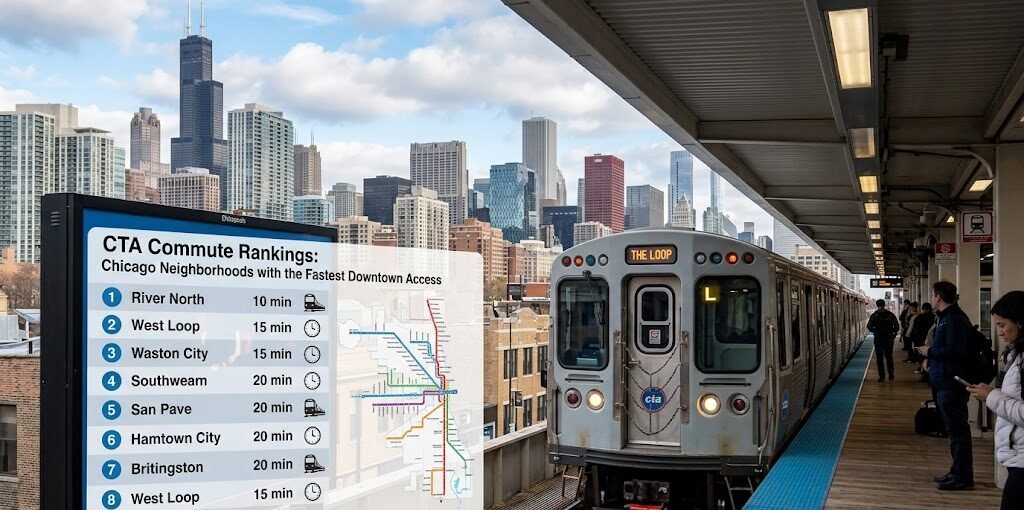
The Loop and immediately surrounding areas offer unparalleled commute convenience. Neighborhoods such as West Loop, South Loop, and River North provide direct access to multiple transit lines and are within walking distance of numerous CTA stations. Residents in these areas often experience commute times of 15-25 minutes to major employers throughout downtown.
Red Line Corridor
The Red Line’s extensive reach makes neighborhoods along this route exceptionally convenient. From Edgewater in the north to Englewood in the south, Red Line neighborhoods provide reliable access to the Loop and other employment centers. Communities like Lincoln Park, Lakeview, and Hyde Park benefit from direct service without requiring transfers.
Blue Line Access Points
The Blue Line’s dual paths to downtown make it highly valuable for commuters. Neighborhoods including Pilsen and Medical District offer quick access to the Loop, often within 20-30 minutes depending on the specific starting point.
Brown Line Communities
Residents of neighborhoods served by the Brown Line, such as Ravenswood and Uptown, enjoy frequent service and relatively direct routes to downtown. These areas provide a balance between residential character and commute efficiency.
Commute Time Expectations by Neighborhood Type
Downtown and Near-Loop Areas (15-20 minutes)
These neighborhoods offer the absolute fastest commutes. Residents can often reach most downtown locations within 15-20 minutes, with some commutes achievable in under 10 minutes.
Inner Ring Neighborhoods (25-35 minutes)
Communities in the inner ring typically experience commutes of 25-35 minutes to downtown employment centers, depending on which transit line serves the area.
Mid-Range Neighborhoods (35-45 minutes)
Areas further from downtown but still well-connected by major CTA lines generally require 35-45 minutes for downtown commutes.
Outer Neighborhoods (45+ minutes)
Neighborhoods on the periphery of CTA service may require 45 minutes or longer to reach central employment districts.
Optimizing Your CTA Commute
Beyond choosing a well-connected neighborhood, several strategies can help minimize your actual commute time:
- Travel during off-peak hours when possible to avoid crowding and delays.
- Utilize the CTA mobile app for real-time tracking and schedule optimization.
- Consider neighborhoods along express routes, which often provide faster service than local lines.
- Evaluate combination commutes that might include biking to a transit station.
- Research employer locations to identify neighborhoods offering direct or single-transfer routes.
- Account for weekend service changes when evaluating neighborhood convenience.
The Value of Proximity to Fast CTA Routes
Living in a neighborhood with fast CTA access extends benefits beyond simple time savings. Shorter commutes contribute to improved work-life balance, reduced transportation costs, and lower environmental impact. Additionally, neighborhoods with strong transit connections typically feature higher walkability scores and greater access to local amenities.
For those prioritizing commute efficiency in their neighborhood selection, focusing on areas with direct access to major CTA lines offers the most significant advantage in reaching downtown and other employment centers quickly and reliably.
Conclusion
Chicago’s fastest commute neighborhoods cluster around downtown and along the city’s primary transit lines, particularly the Red, Blue, and Brown Lines. By understanding which neighborhoods offer the most efficient CTA access, prospective residents and current commuters can make informed decisions about where to live and work. Whether prioritizing speed, neighborhood character, or a combination of factors, Chicago’s diverse communities offer options for nearly every commuting preference and lifestyle priority.